

Authentic Montessori
We believe that children are naturally born with the inner directive to meet their own needs and to learn. Our goal as Montessori educators is to embrace this innate drive by providing optimal learning environments for our bright, engaged, and inquisitive students. Regardless of developmental stage, the opportunity to choose your own activity, to move and work freely within the ground rules, and to work for long blocks of time without interruption are fundamental elements of learning the Montessori way. The Montessori education method was developed over years of research in classrooms, discovering how children learned and developed. The Montessori curriculum is customised to meet the developmental needs of the child each step of the way. Your child has the opportunity to explore their own passions, while being guided to develop the needed skills which sets them up for success later in life!
Montessori & Brain Development: Success in Learning & Life
“The study of executive functions has a long history in psychology and has lately become prominent in child development as we have discovered that executive function (or self-control or self-regulation) is an extremely important predictor of life outcomes – more important than intelligence, and above and beyond other key influences such as parent income and education.”
Prof Angeline Lillard
Montessori: The Science Behind the Genius
(3rd Edition)
The brain’s Executive Functions are encouraged and developed in an authentic – bilingual – Montessori environment at each level (Toddler through Adolescence) – building strong foundations for learning and life.
Dr. Maria Montessori observed that as a child gets older, they move into distinct new stages of development, and so learn differently as they grow. This brain development is influenced by experience. Younger children learn by actively engaging with hands-on materials, while older children are engaged by stories. The Montessori environment nurtures children in each stage of their development by catering to their changing needs.
This unique approach embraces children’s curiosity and allows them to learn in a natural way through exploration, experimentation, and collaboration.
The importance of the brain’s Executive Functions (self-regulation) has become a topic of great interest recently, as recent Longitudinal research has turned developmental psychology on its head: showing that strong Executive Functions at age 4 are a more important predictor of positive life outcomes than intelligence, parent income, and education.
The phrase “executive function” refers to a set of skills. These skills underlie the capacity to plan ahead and meet goals, display self-control, follow multiple-step directions even when interrupted, and stay focused despite distractions, among others.
An authentic – bilingual – Montessori environment encourages effective brain development of the Executive Functions at each level (Toddler through Adolescence) – building strong foundations for learning, creating, and success in life.
Individualised and Social
Montessori is Social
The highly social atmosphere of the Montessori environment stems from a unique combination of freedom and structure founded on mutual trust. The very young child quickly learns self-control: choosing materials, where to work and with whom. Children from birth to six prefer to work side by side with friends. Elementary age children need social interactions and learn in groups. The teen craves a community of peers.
The Montessori environments are designed to encourage learning about working and playing in a community appropriate to each successive developmental stage. Children develop strong social skills as a result.
Montessori is Individual
The Montessori curriculum is customised to the unique needs of each individual child and their stage of development. Rather than the child following a strict curriculum for the entire class, the Montessori curriculum follows the interests and skill-level of each child. The result is that the child is never left behind, nor is the child bored from lessons that are not sufficiently advanced. A Montessori child is constantly striving to achieve success in increasingly difficult pursuits, which sets them up for success later in life.
Prepared Environment
Step into a Montessori classroom or “environment” as we call it, and you will immediately notice that the space looks very different from other school settings. When a child first enters a Montessori environment, they often react with delight because “this is ‘just right’ for me!” Everything is scaled to the child’s size, including furniture, utensils, cleaning implements, and the Montessori materials themselves. This is the prepared environment: a meticulously arranged space designed to encourage the child’s growth and learning – physically, cognitively, socially, and emotionally. By the time the child is Upper Elementary, the environment has grown with them, and the furniture is almost adult-sized.
Abundant research shows that movement and cognition are closely intertwined. People represent spaces and objects more accurately, make judgments faster and more accurately, remember information better, and show superior social cognition when their movements are aligned with what they are thinking about or learning. Conventional classrooms are not set up to capitalize on the relationship between movement and cognition. In contrast, Montessori has movement at its core.
Prof Angeline Lillard
Montessori: The Science Behind the Genius
(3rd Edition)
Montessori & 21st Century Skills
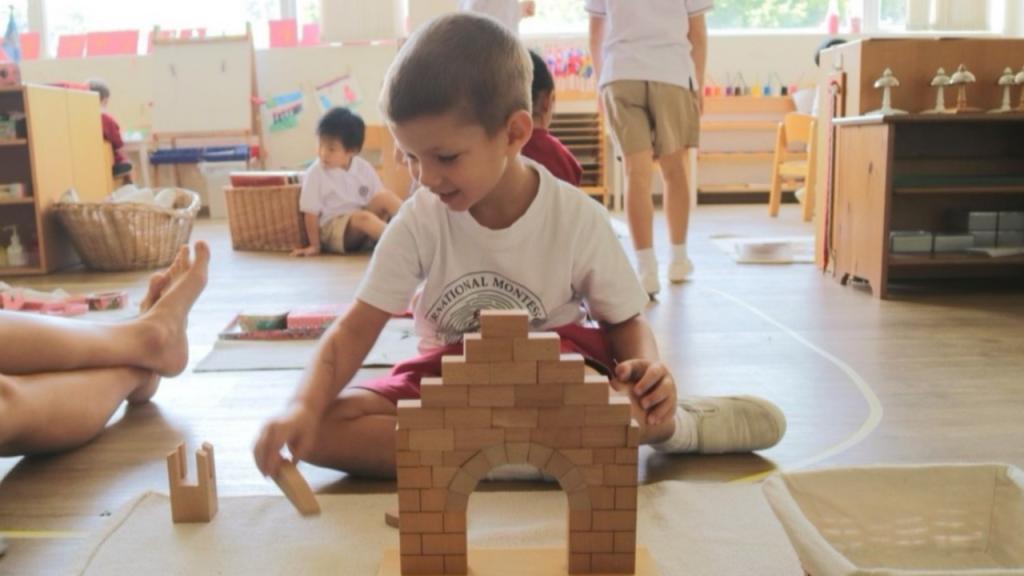
Try to imagine what the world will look like 20 years from now. What sorts of jobs are going to be available? What skills will be needed? We know these keep changing! That is the world that we are preparing our children for today. This is why the Montessori approach is so important in the fast-changing, modern world.
Why do we need 21st Century Skills:
Skills are Changing…learn more here
Preparing Children Today for the World of Tomorrow
A Montessori environment allows children to construct themselves as adaptable, educated, responsible, independent, and conscientious adults. The approach pushes each child to become self-disciplined, flexible, creative, and motivated: have built the skills they need to influence positive change in whatever they choose as their life’s work from entrepreneur to musician.
How? By training the child’s executive functions, which are the brain functions which control goal-related behaviours which are the predictors of success in efforts.
The goal of the Montessori method of education is to allow children to construct themselves as adaptable, educated, responsible, independent, and conscientious adults.
Montessori Magic! Students investigate sources of waste at IMS and turn that into a composting project and a recycled paper-making business.
Montessori Magic! Students investigate sources of waste at IMS and turn that into a composting project and a recycled paper-making business.
Follow your passion! One student shares how his love for swimming led him to start a charity for children who don’t have the swim gear they need to participate in swimming.
IMS children surprise others with their professionalism! Upper Elementary students work with the Jane Goodall Institute to create a community map for the Stanley area. “I have taught this programme to many local and international schools… This is what we dreamt that Community Mapping could be… IMS kids have gone above and beyond our expectations.”
Hear more from our Alumni and Parents!