

Dual-Language
At IMS, the children are completely immersed in a truly dual-language Montessori environment. Each classroom is guided by two teachers, one a Putonghua-speaker and one an English-speaker who exclusively speak their native language to the children. The children are exposed to speaking, listening, reading and writing from the earliest ages in both English and Chinese, very naturally. Children are constantly picking up new vocabulary from their teacher and their peers in both languages. In the Elementary programme, children attend separate small group Chinese lessons based on their ability. These lessons allow them to learn new vocabulary and skills to reinforce later in their dual-language classroom.
Dual-Language In The Classroom
The Montessori Dual- Language Classroom:
-Includes 25 children of mixed ages, working mostly individually. Older children who are approaching the Age of reason will naturally begin to work in small groups.
-Has two teachers, at least one of whom is a fully qualified AMI Montessori teacher.
-One teacher is an English speaker, and one is a Putonghua speaker, who introduce materials individually to each child.
-The natural dual-language environment occurs in the morning three-hour Montessori work cycle, with some older children staying after lunch for continued work in the afternoon work cycle.
-The dual-language environment has many specialised Montessori materials which assist the child to learn the structure of the written language.
-Activities occur regularly throughout the week, before or after the three-hour cycle, including PE, Music & Movement, and circle times.
Dual-Language Immersion:
The young child craves language to be able to communicate and describe the world. Spoken language is the foundation for all creation of language in the child, and opens the door for all future learning. In the IMS Casa dei Bambini classroom, the child begins to develop an instinctive sense of language through natural exposure to English and Putonghua. Every environment has an English-speaking and a native Putonghua-speaking teacher to surround the child with opportunities to absorb and acquire language naturally throughout each day.
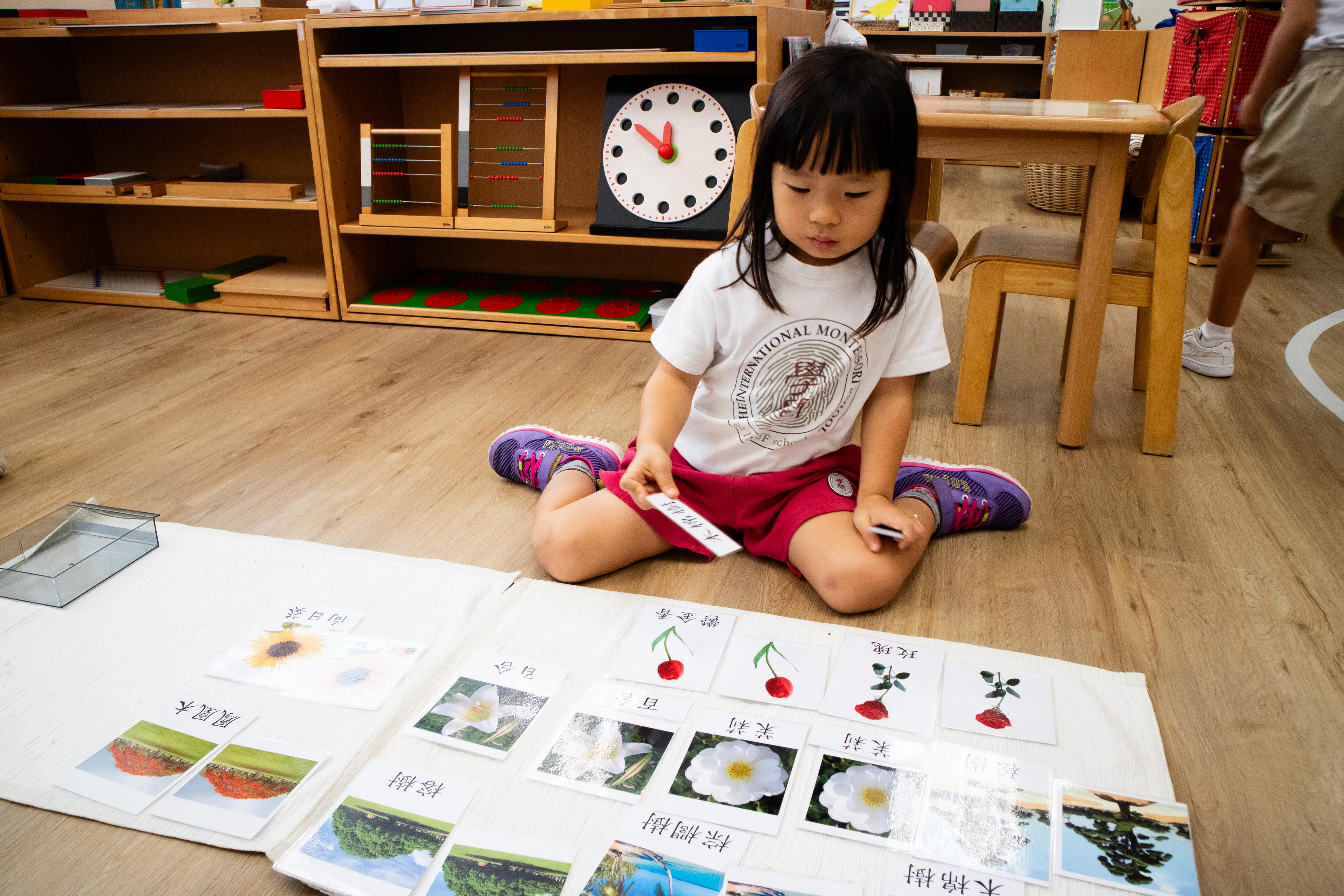
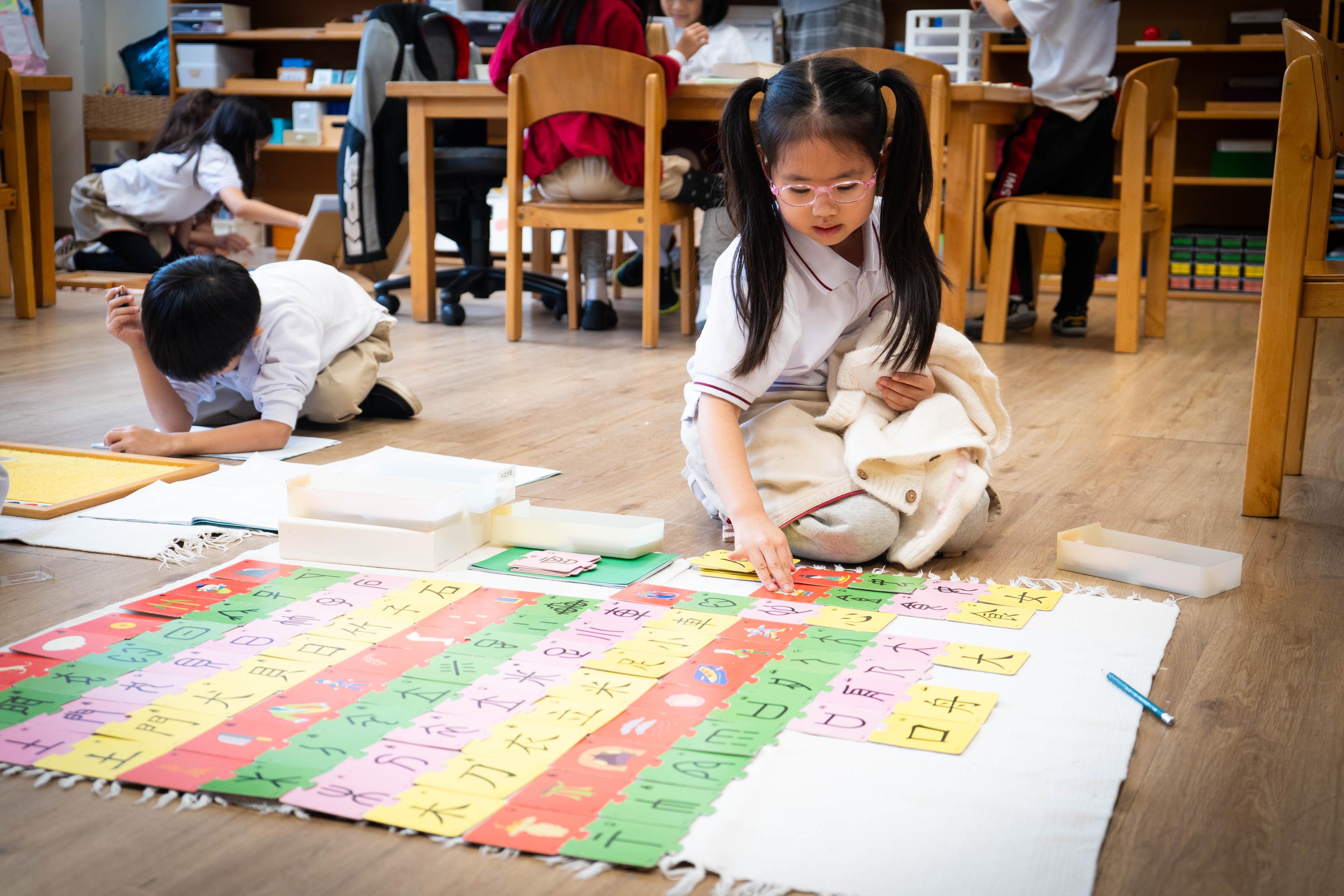
Our language programme in the early years is patterned closely after the native language experience: first oral learning with rhymes, philosophical stories, and song, then followed by character recognition, proper character formation, including stroke order and radicals. IMS has pioneered many Chinese materials which encourage children to form Chinese characters. Chinese is a pictorial language and a very young child can often recognise a character well before an English word can be read and sounded out.
Upon entry into the Casa dei Bambini community, the three-year-old has more older and experienced children who are happy to guide their younger peers. The teachers encourage this peer-to-peer learning.
To give the child meaningful work to help them settle into the class, the new child typically gets many lessons with the practical life materials, in both languages, so that they have many activities they can choose from. The young child absorbs language equally quickly, learning vocabulary to describe what they are doing from both the teacher and from the other children.
The child explores the Sensorial materials, learning to describe what his senses perceive or her observations of spatial relationships, which helps form the mathematical mind. When the mathematics materials are introduced, often the child counts more quickly in Chinese than English!
Cultural areas are fascinating to the young child, and are explored in both languages over the three year period, as the child develops and understands more and more about the world around, and is better able to communicate this.
Children work independently in a specially prepared, dual-language environment, guided by both English-speaking and Chinese-speaking teachers who introduce specially designed Montessori Materials to each child individually. IMS has pioneered special Chinese Montessori materials for very young children to learn these complex characters. This is an ideal time for a child to learn these characters, as the innate love of repetition for mastery drives the child to synthesise this information.
Typical Chinese Language Level by Age 6:
By the age of six, a typical IMS child is able to understand what the Chinese teacher says to them. They are able to hold a conversation using the correct tones and has a great deal of descriptive vocabulary.
Over 300 of the complex characters have become quite familiar by this point, and they can write numbers, their own name. They can use proper stroke order to write a number of the recognised Chinese characters using proper stroke order.
Level of fluency in listening, speaking, reading and writing are all influenced by the home environment. Language acquisition is ideally as natural a process as possible for the young child. If you have the gift of bilingualism in your home, we encourage you to pass this on to your child. Learning more than one language exposes a child to a concept of thinking in a different way, which increases creativity. Learn more about the benefits of early bilingualism.
Assessment for readiness for the Montessori Lower Elementary programme results in placement in the best suited Chinese language small group environment in the Elementary years, which are differentiated based on the child’s written and spoken language skills.
Speak, Write And Read In Chinese
IMS is a Dual-Language School, where Chinese culture and language are integrated throughout every aspect of the child’s experience. Every classroom, from Foundation to Upper Elementary, is guided by two teachers, one who always addresses the children in English while the other always speaks Chinese. In this complete and consistent Dual-Language environment, the child is surrounded with opportunities to acquire language naturally throughout each day. Full-time exposure to two languages along with multi-sensory language materials allow children to effortlessly absorb and experience each as a “living language” through day to day life in the classroom.
By living and learning amongst two languages, our students develop an openness to different cultures and habits. Given the chance to listen and participate in an environment rich in a different language, children assimilate meaning because the new words they hear are in context. Children naturally absorb a second language in much the same way they acquire their first language. Instead of being simply taught in a formal way for specific duration during the week, Chinese permeates the learning environment and becomes a means of communication, and a medium to teach other subjects.
This constant exposure, coupled with the freedom to speak and to interact, facilitates an early ease of code-switching between two languages. When the brain’s executive control system is continually stimulated by consistent dual-language experiences, the child efficiently hones the ability to direct his attention processes, including attending to relevant information, while ignoring distractions.
Students are also able to transfer their connection between multiple labels of meaning to other disciplines. Our Dual-Language programme promotes not only bilingualism and biliteracy, but also fosters a genuine respect and understanding of the people and cultures involved.
IMS Alumni Testimonial
Speaking
The young child craves language to be able to communicate and describe his world. Spoken language is the foundation for all creation of language in the child, and opens the door for future learning. Dr. Montessori discovered that children universally create language directly from what they absorb from their surroundings. As spoken language serves as a foundation for the child’s later facility of reading and writing, emphasis is placed on establishing a solid oral-auditory experience first by the Chinese teacher. Children initially learn to adapt to hearing the living language through their daily routines in their dual-language classroom.
As spoken language serves as a foundation for the child’s later facility of reading and writing, emphasis is placed on establishing a solid oral-auditory experience first by the Chinese teacher. Children initially learn to adapt to hearing the living language through their daily routines in their dual-language classroom. While the new child may respond in any language he chooses, the teacher consistently only speaks in Chinese to him. The teacher might engage children in conversation about their clothing, their weekend, or their snack, using gestures to convey the meaning of new vocabulary. In the mixed-age community, often an older peer who is listening in will spontaneously join in to translate for a new child who is still adjusting to the new language. The children learn the names of all the attractive materials on the shelves and practise repeating the names of the real Practical Life objects that they are using each day. The vocabulary acquired during this stage is applicable and useful to their everyday life at school and home. Enthusiasm for Chinese is also built through stories, poems, songs, and fingerplays. It is common to overhear children spontaneously singing these newly learned songs while they work. During story time, the teacher asks open-ended questions (who, what, when, where, why, how) to stimulate natural conversation.
Reading
Children are introduced to vocabulary through replica objects and Classified Picture Cards. At this age, they need to see and feel things to process new information so if the real object is available, we would invite them to touch and experience it to gain a more meaningful connection. Because Chinese is not phonetic, the progression to reading happens differently. Each Chinese character is a puzzle word that can be memorised visually like an image from a young age. At IMS, we use traditional characters because we believe a child should be able to associate and connect language with his greater surroundings in Hong Kong.
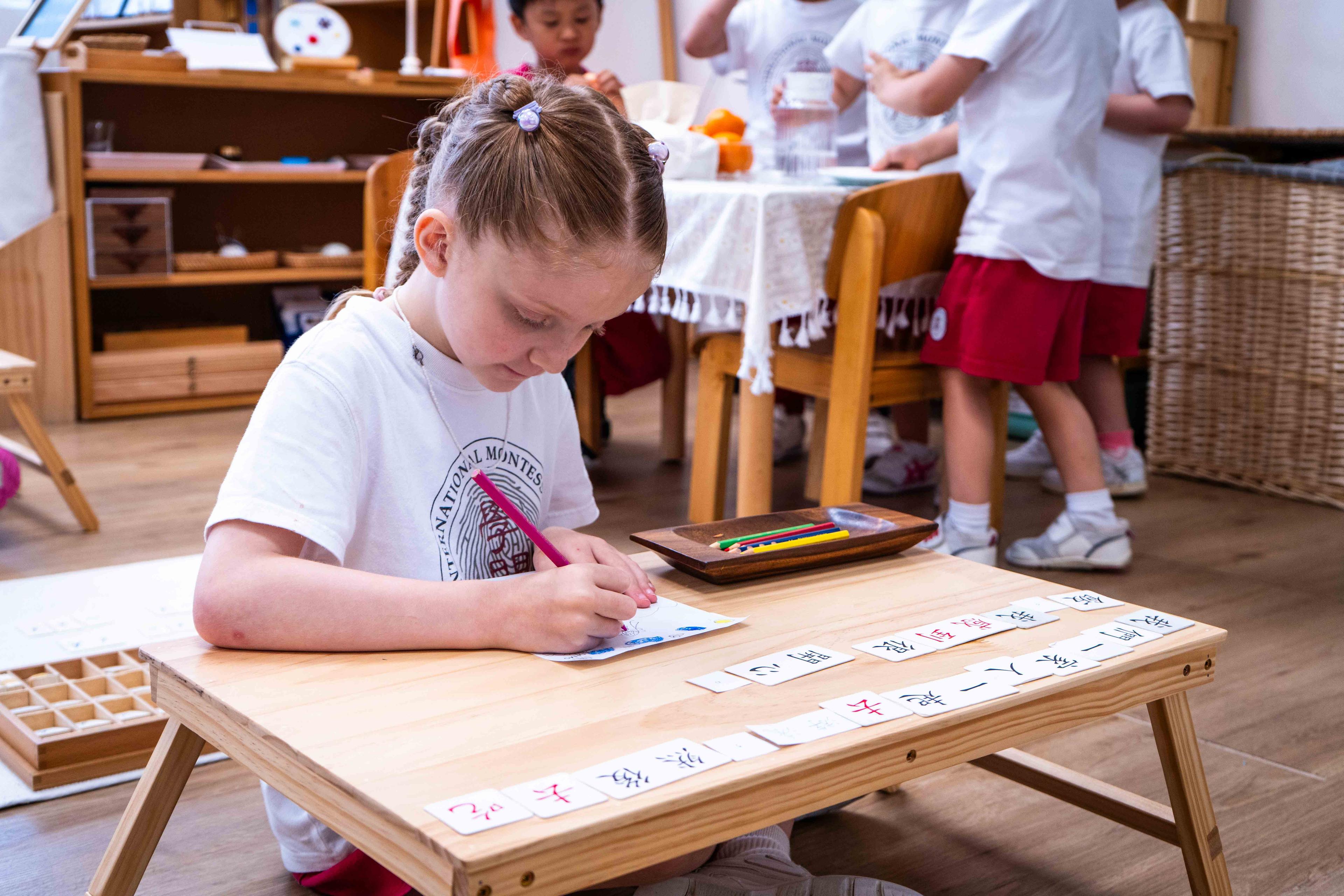
If he is able to recognise characters in his community, he can directly apply his knowledge and use the language practically. As well, to highlight the child’s focus on recognising and identifying characters, pinyin is not used at this developmental stage; it is later introduced in Elementary after the child has established phonetic reading. When the child has gained recognition of both picture and character separately, he is invited to pair the picture image with its written symbol. When he has consistently retained a greater number of characters, he is guided to read short illustrated stories which are based on repetition Character recognition also builds toward the formation of simple sentences by using Moveable Characters, that allow the young child to express written thoughts even before they are ready for pencil and paper.
Writing
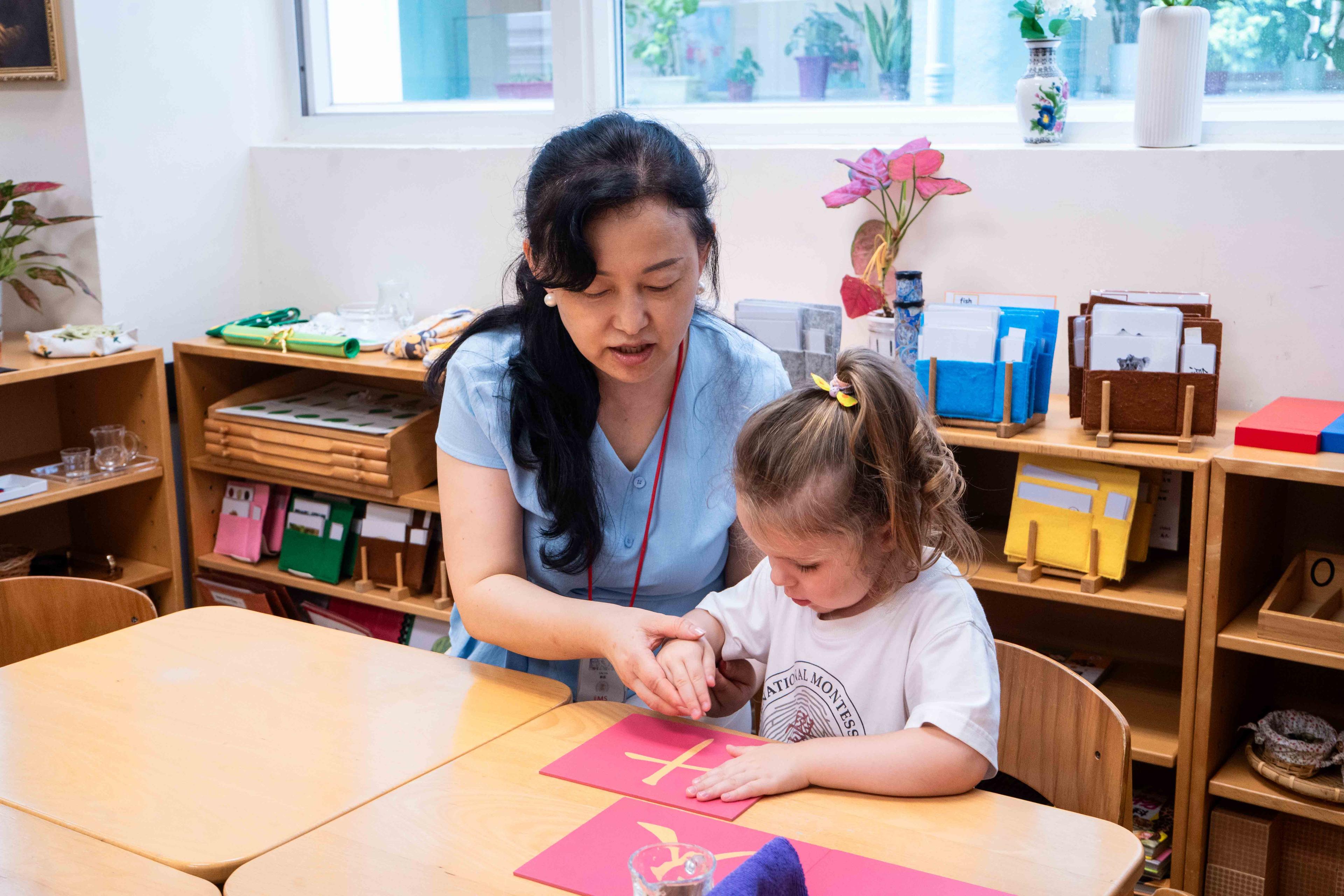
The hands-on materials in the Casa environment provide the child with an abundance of practice beforehand so that when he goes to use the pencil to write, he is prepared, eager, and ready. IMS has pioneered these special Chinese Montessori materials for very young children to learn how to write simple to complex characters. This is an ideal time for a child to trace these characters, as the innate love of repetition for mastery drives the child to synthesise this information. Emphasis at this stage is placed on establishing correct stroke order and solidifying the pictorial images of the fundamental characters through tactile impressions.
Between the time of birth and six years of age, the child’s motor mechanism is fixed and as the body’s instrument to write, the hand must be trained with care: “[It is] the most precious instrument of the human will” (Montessori, Discovery of the Child). Before writing, the child’s hand and pincer grip must first be thoroughly prepared through extensive use and repetition of the Practical Life and Sensorial activities. If we give a child a pencil to practise writing before his hand is physically ready, it often results in frustration and poor habits, such as improper grip. After the child is invited to write characters using different implements such as chalkboards, sand trays, and white boards, which can be reset easily without leaving a smudge of a mistake. Joyfully, the child begins to form simple characters, that have been embedded in his memory through repeatedly tracing. Later he progresses to writing simple sentences and stories with illustrations using pencil and paper.
Elementary Chinese
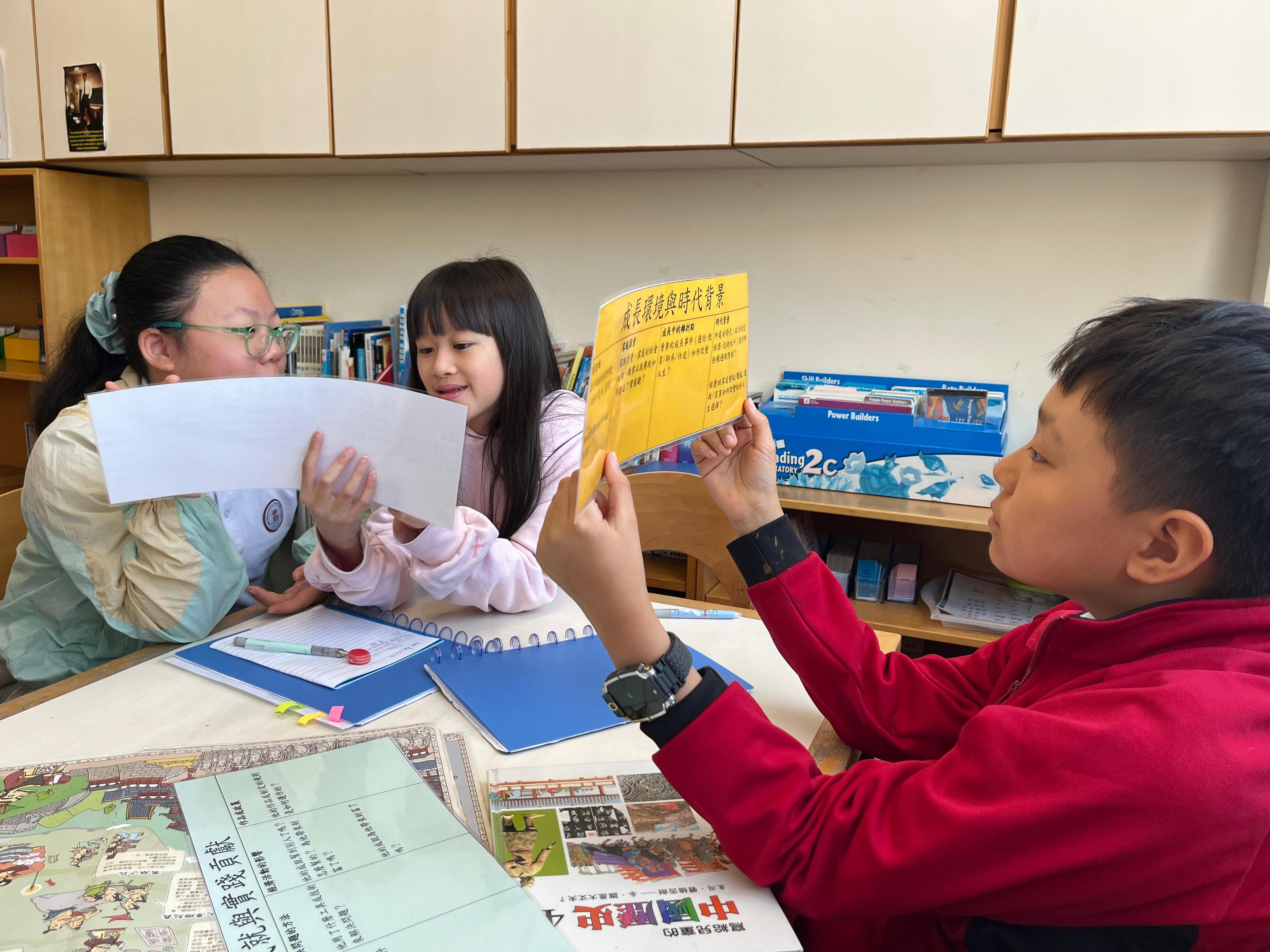
One of the key differences between Elementary and Casa is that the 6-12 child conveys a strong preference to work in groups. The child becomes intensely social and to match this development need, lessons are nearly always given to a group. At this level, Chinese is also added as a daily specialist subject in addition to the Dual-Language environment. These 45 minute lessons are given in small groups targeted at the Chinese language level and ability of each child. Emphasis is placed on growing a language learner who is comfortable and confident in all aspects of listening, speaking, reading, and writing. The curriculum uses specific textbooks and leveled readers to allow tracking of progress, along with many multi-sensory materials to extend the student’s language acquisition. Retaining and writing characters from memory is a new and critically important part of learning at this stage.
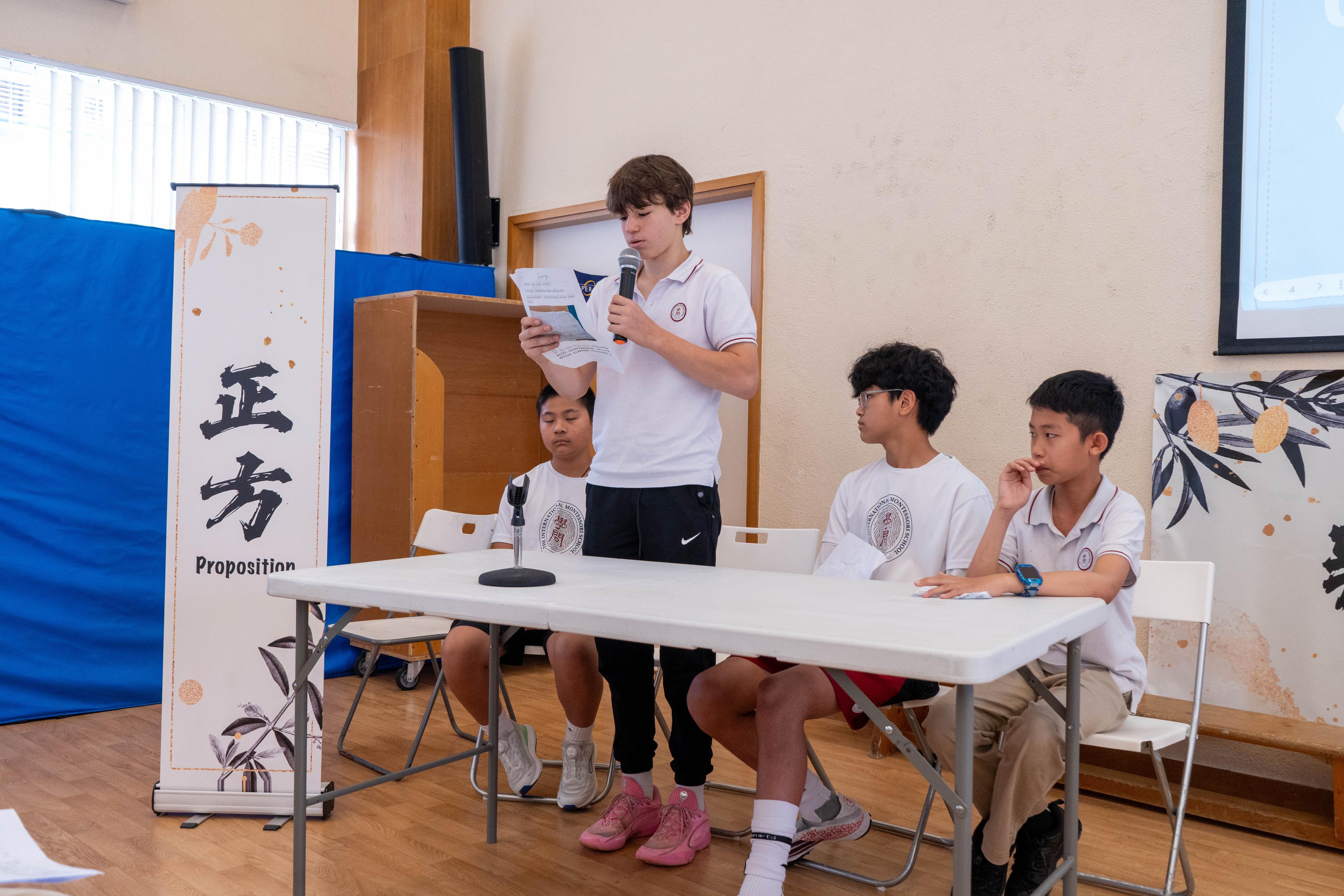
Pin Yin is introduced at this level as another tool to access reading. As the 6-12 child is deeply passionate about the arts during this stage of development, they also read philosophical tales, write creative stories and plays, and perform interpretations of drama and dance on stage. In the Elementary classroom, the Chinese teacher closely supports and encourages the extension of the Montessori work in Chinese. As their comprehension and expressive abilities strengthen, the children’s Chinese becomes increasingly integrated in the other subject areas and they will begin to use the language interchangeably. This could vary from a student getting help from a Chinese teacher to solve a maths problem, to answering questions in Chinese about the observations of a science experiment, or to extending an ancient Roman history project to research events in China around the same period.
Chinese in the Early Years
IMS is a Dual-Language School, where Chinese culture and language are integrated throughout every aspect of the child’s experience. Every classroom, from Foundation to Upper Elementary, is guided by two teachers, one who always addresses the children in English while the other always speaks Putonghua. In this complete and consistent Dual-Language environment, the child is surrounded with opportunities to acquire language naturally throughout each day. Full-time exposure to two languages along with multi-sensory language materials allow children to effortlessly absorb and experience each as a “living language” through day to day life in the classroom.
-Includes 25 children of mixed ages, working mostly individually. Older children who are approaching the Age of reason will naturally begin to work in small groups.
-Has two teachers, at least one of whom is a fully qualified AMI Montessori teacher. One teacher is an English speaker, and one is a Putonghua speaker, who introduce materials individually to each child.
-The Dual-Language environment has many specialised Montessori materials which assist the child to learn the structure of the written language.
-Activities occur regularly throughout the week, before or after the three-hour cycle, including PE, Music & Movement, and circle times.
Dual-Language Immersion
The young child craves language to be able to communicate and describe the world. Spoken language is the foundation for all creation of language in the child, and opens the door for all future learning. In the IMS Casa dei Bambini classroom, the child begins to develop an instinctive sense of language through natural exposure to English and Putonghua. Every environment has an English-speaking and a native Chinese-speaking teacher to surround the child with opportunities to absorb and acquire language naturally throughout each day.
Chinese STEAM in Elementary
The Elementary aged child begins to develop a Reasoning Mind and craves social interaction. The dual-language immersion experience changes in response:
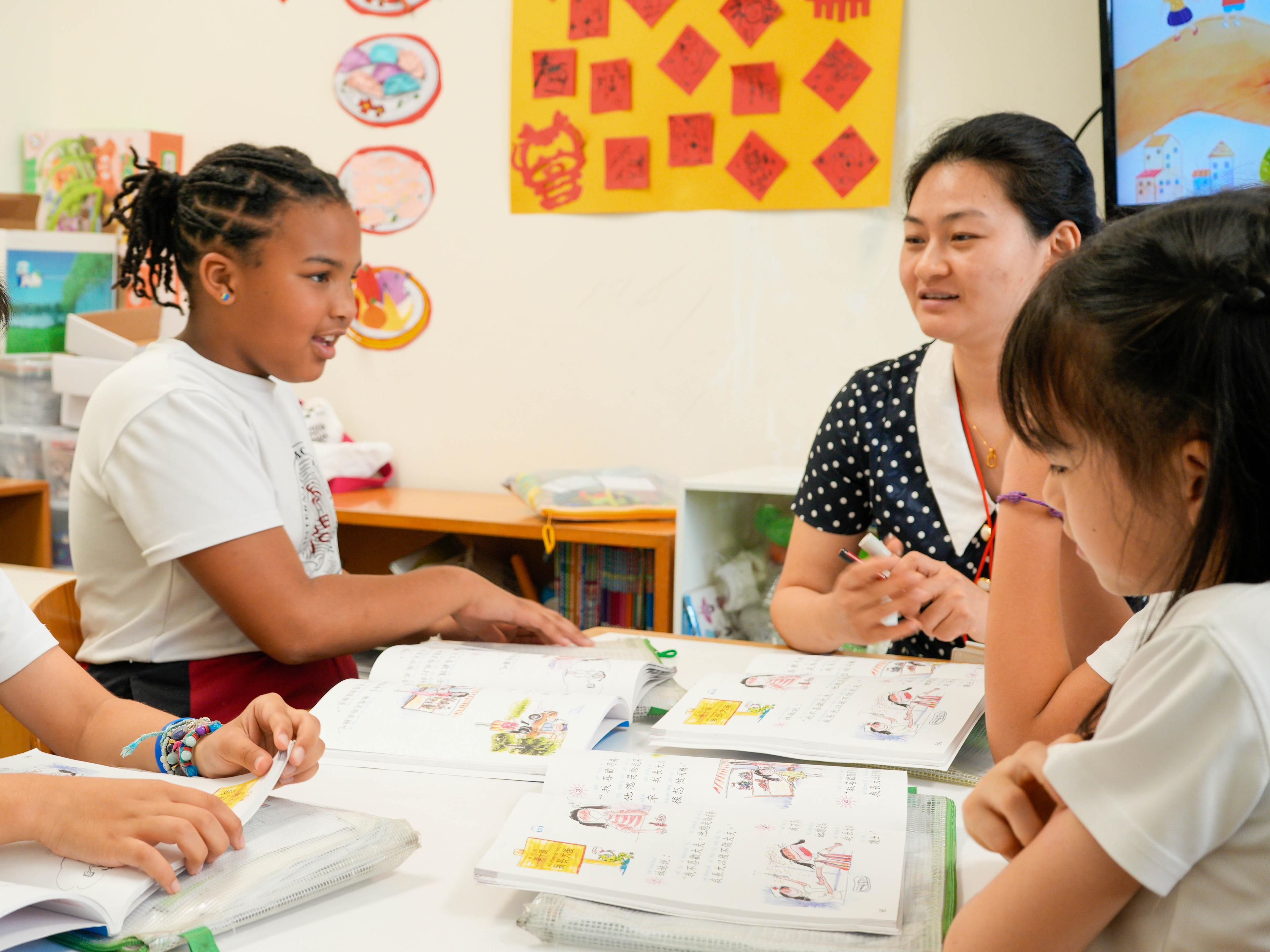
Dual language immersion continues to permeate the children’s daily lives. On most day the children participate in one three-hour Montessori work cycle, and a similar, shorter work cycle. During the cycle, the English-speaking teacher provides small-group lessons and overall guidance for work in the class and the Chinese-speaking teacher closely supports and encourages the extension of the Montessori work in Chinese. In addition, each child participates in a tailored Chinese lesson each day for forty-five minutes. These lessons are given in small groups targeted at the Chinese language level and ability of each child. The curriculum uses specific textbooks to allow tracking of progress, along with many multi-sensory approaches to extend the student’s language acquisition.
Fitting The Elementary Chinese Lesson To The Learner Profile
The Chinese language curriculum in the IMS Elementary Programme is specifically designed to cater to children across a broad spectrum of abilities, including those children who join us in Elementary from other schools. Children from different classes are combined into small groups which are differentiated by ability in Chinese; from near-native or native-speaker to the beginner.
These small group lessons take place each day, and are designed to allow the children to learn all aspects of the Chinese language: speaking, listening, reading and writing (using the complex/traditional characters introduced in the Casa dei Bambini). Retaining and writing characters from memory, including proper stroke order, is a new and critically important part of learning the Chinese language in Elementary. IMS programmes are designed to encourage the child to continue to love learning in Chinese.
At entry, IMS Elementary Chinese teachers make a recommendation for the best fit for each child in our Elementary Chinese Programme to ensure that the child maintains confidence and feels successful in the new environment. Ongoing monitoring at school continues to ensure that the grouping continues to be most suited to supporting each child’s continued joyful Chinese language learning and development.
MS has one of the strongest Chinese programmes in Hong Kong, and most of our children who have been with the school from the Casa dei Bambini enter the highest groups of Chinese in their secondary schools. Those children who are with us for even just a few years quickly find Chinese to be an area where they can excel, and quickly communicate beyond their parent’s ability.
Benefits of Bilingualism
Gift Of Bilingualism
If you have the gift of bilingualism in your home, we encourage you to pass this on to your child. For years, research has shown that language learning at an early age has great benefits. Most recently, a May 2015 study published in “Science Daily” suggests that exposure to multiple languages in childhood produces better communicators (“Children exposed to multiple languages”). A 2014 study in Singapore showed that infants exposed to multiple languages showed increased behaviors that predict cognitive gains in preschool (“Benefits for Babies”). A 2012 post at the Dana Foundation is a rich resource and expounds “The Cognitive Benefits of Being Bilingual” (Marian and Shook). Educators are aware of the research, which seems to be reported anew nearly weekly.
At IMS as a Dual-Language School, Chinese culture and language are integrated throughout every aspect of the child’s experience. Every classroom, from Foundation to Upper Elementary, is guided by two teachers, one who always addresses the children in English while the other always speaks Chinese. In this complete and consistent Dual-Language environment, the child is surrounded with opportunities to acquire language naturally throughout each day. Full-time exposure to two languages along with multi-sensory language materials allow children to effortlessly absorb and experience each as a “living language” through day-to-day life in the classroom. By living and learning two languages, our students develop an openness to different cultures and habits. Given the chance to listen and participate in an environment rich in a different language, children assimilate meaning because the new words they hear are in context. Children naturally absorb a second language in much the same way they acquire their first language. Young children associate the language with the speaker, so teachers are particularly careful to only use their native language with the children.
Strong language skills provide children a foundation for all of their learning. Multilingualism, specifically, has been linked to improved focus, abstract thinking, task switching; and even health benefits like delayed Alzheimer’s, among others. At IMS, the dual-language programme is at the heart of all learning, providing natural exposure to both English and Putonghua.
These benefits come from exposure to describing the world around using different cultural lenses of perception and thinking which are embodied in a language, which increases creativity and enhances social skills through expanded perceptions of that world.Elementary